



Most people invest in property to build wealth or create financial security. While the property you purchase plays a key role, investment property loans, tax deductions, structuring, capital gains tax (CGT), and other factors all impact your financial position at the end of the day.
Getting started in property investing means learning a few new concepts along the way. This guide breaks down the fundamentals of investment property finance and tax, giving you a solid foundation before speaking with your mortgage broker, accountant or financial adviser.
The information in this article is general information only, not financial or tax advice. For personal advice, please consult a licensed broker, accountant, or financial adviser.

Investment Property Loans Explained
Investment property loans are assessed differently from regular home loans. In addition to your deposit, income, debts, expenses, and rental returns, lenders also consider the property’s potential rental income. However, some lenders may only count a portion of the rent to account for vacancies and holding costs, such as rates, repairs, and management fees.
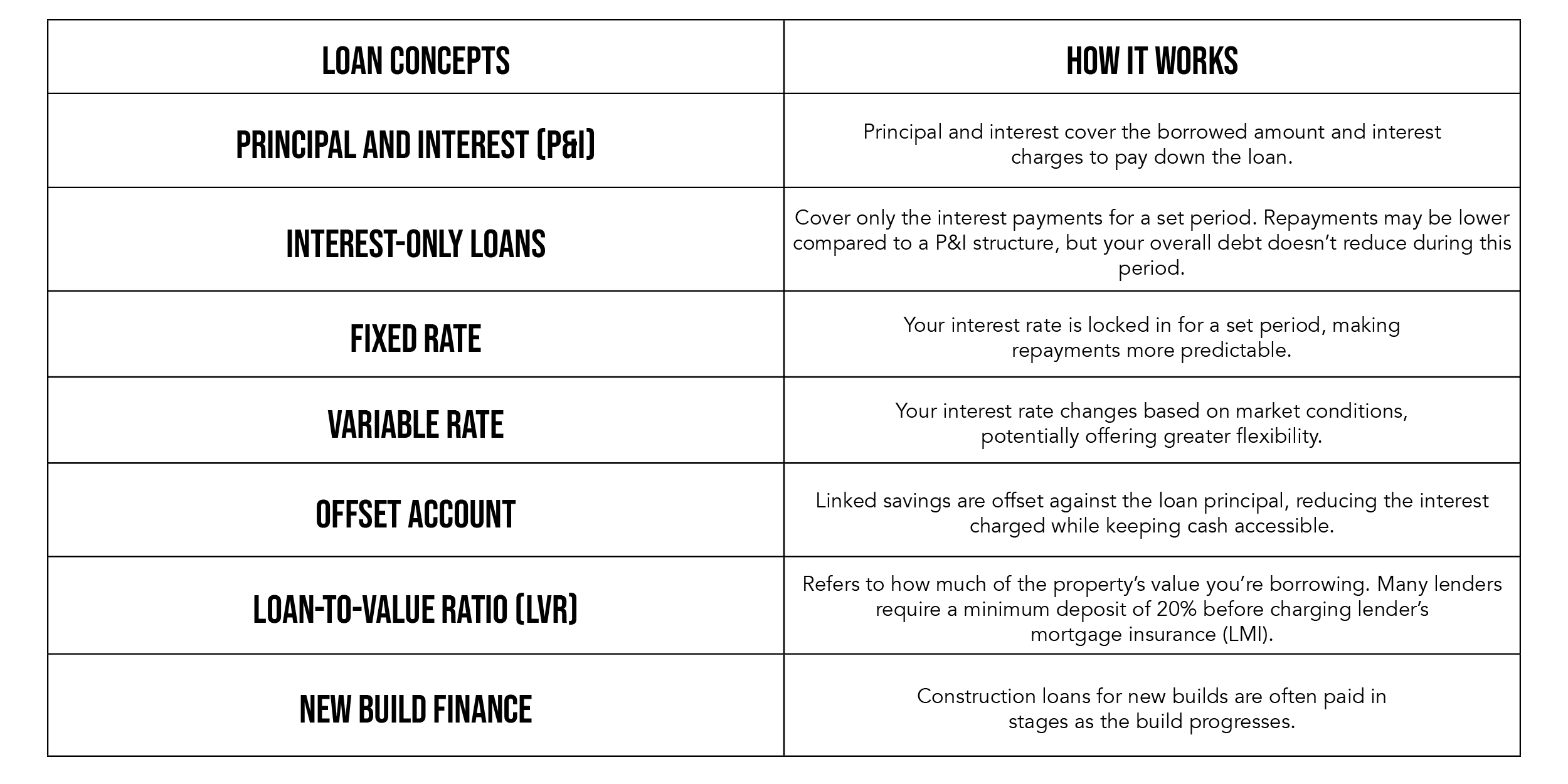
Let’s take a look at some of the basic loan concepts you’re likely to come across when researching investment property loans, and how they work:
The most common investment property tax deductions
Depending on when you purchased an investment property and the type of investment property you own, you may be able to claim a tax deduction for the costs of holding and managing an investment property, including:
Interest charged on the investment property loan.
Property management fees paid to an agent for tenant management, rent collection, and inspections;
Insurance, such as landlord, building, or other eligible property-related insurance;
Council rates and strata fees;
Repairs and maintenance costs to fix wear and tear, rather than improve or replace part of the property;
Depreciation on plant and equipment (Division 40), and capital works (Division 43).
The Australian Government announced major negative gearing reforms as part of the 2026–27 Federal Budget. While negative gearing still applies to new builds, it’s important to check how these changes affect you.

How depreciation impacts new build investment properties
Depreciation refers to the decline in value of eligible building work, fittings, and fixtures over time. In some instances, investors may be able to claim depreciation as a tax deduction.
New builds tend to offer greater depreciation benefits than established homes because their construction, fixtures, and fittings are newer. While depreciation shouldn’t be the only factor in your decision, it’s one reason why comparing new release land in Box Hill with established properties across Northwest Sydney may be worthwhile.
Before deciding on an investment property loan, speak with the MAB Sydney team for personalised finance guidance tailored to your circumstances.
Negative vs positive gearing
Negative and positive gearing offer their own unique benefits and drawbacks. A positively geared investment property generates more rental income than it costs to hold. While this provides immediate cash flow, it also increases your taxable income.
Negative gearing means that it costs more to hold an investment than the rental income in brings in, creating a loss that can be used to reduce your taxable income.
Here’s a simple comparison:

How capital gains tax on investment property works
Capital gains tax (CGT) on an investment property is the tax you may pay if you make a profit from selling. The amount of CGT you pay is calculated by subtracting the purchase price from the sale price (after eligible costs).
If you hold the property for 12+ months, you may be eligible for the 50% CGT discount. However, the recent tax reforms may impact how capital gains are taxed.
Why growth corridors like Box Hill suit investors
Fast-growing suburbs can be attractive to property investors, particularly where new homes, schools, shopping centres and transport infrastructure are driving long-term demand. Box Hill is a great example of a thriving growth corridor, attracting a growing population as Sydney’s north-west continues to expand.
Combined with the depreciation benefits of a new build, many property investors are considering The Hills of Carmel land for sale over buying an established investment property.
FAQ
How much deposit do I need for an investment property?
Most lenders require a minimum deposit of 20% before charging lender’s mortgage insurance (LMI).
Can I use my super to buy an investment property?
If you have a self-managed super fund (SMSF), you may be able to purchase an investment property through your super, but it isn’t possible through a standard super fund.
How much do I need in super to buy property through an SMSF?
To purchase an investment property throug your SMSF, you’ll need sufficient funds to cover your deposit, buying costs, SMSF costs, loan requirements, and your retirement strategy. SMSF property investing is highly complex, so it’s essential to seek professional advice.
Is it better to buy new or established for tax purposes?
New properties typically offer significant depreciation deductions compared to established homes because the building, fittings, and fixtures are newer. Established properties may still offer tax benefits, but it depends on the property and expenses.
What’s the difference between Division 40 and Division 43 depreciation?
Division 40 and Division 43 refer to two categories of depreciation deductions:
Division 40 generally covers depreciation of plant and equipment, such as eligible appliances or fixtures.
Division 43 usually covers eligible capital works, including parts of the building structure.
Can I live in my investment property?
If you own the property personally, you can generally choose to live in it. However, doing so may affect its tax treatment, including deductions you can claim and how capital gains tax applies when you sell. If the property is owned by a self-managed super fund (SMSF), you and other related parties (e.g. SMSF members or their family) can’t live in it or rent it.
The information in this article is general information only, not financial or tax advice. For personal advice, please consult a licensed broker, accountant, or financial adviser.
Ready to Take the First Step at The Hills of Carmel?
Your first home is more than just a purchase – it’s the beginning of a new chapter. With the right guidance, government support and a welcoming community, that chapter can start sooner than you think.
At The Hills of Carmel, we’re proud to support first home buyers with thoughtfully designed homes, connected neighbourhood spaces and a community built for long-term living.
Visit our Sales Centre or get in touch with our team today to explore available homes and learn how your first home journey can begin at The Hills of Carmel.